Friday, April 10, 2020

Episode 8: On the Nature of Feedback

"So visitors," she asked, "let's hear what you thought of the meeting and give us some feedback."

Oh four letter word, I thought. Well, she did ask for it.

I visited my mom's Toastmasters group today. We started at 6:35, so I made sure to wake up early to go for a walk and get breakfast going beforehand. Was it easy? No, and I was still a few minutes late--but at least I was prepared.

Until the point she said that.

Now, I give very blunt feedback. I like to start off every critique to someone new by saying that. It's not that I'm trying to be mean or that I don't believe in the possibility of the work--I just want my words clear, concise, and unable to be misinterpreted.

But, as I was the last visitor, I had a few minutes to think. After all, there are a multitude of different kinds of feedback: knowing which type is wanted is important. That's why I like to ask my kids what combination they'd like; do they want affirmation, grammar, and/ or content? (Ah, the joys of not having to give a grade).

A mismatch of expectations with reality can lead to terrible results. And, from what I'd seen in the meeting, they were looking for things to make them feel better (AFFIRMATION!).

I hadn't heard a lot about how to improve.

Take me for example. I'd given a forty-ish second speech that had dipped into the negative end of the spectrum (fault 1) and had repeated itself at the end (fault 2). And what did my evaluator say? That I did well, and there wasn't any constructive feedback since I'd done everything well.

Feedback doesn't just have to be the things done poorly--it can also be the things that are missed.

A moment of silence caught my ear. The first person was done talking (I'd been listening! They'd talked about how he'd enjoyed the meeting and how cool it was to see everyone perceiver with the technology that they were unfamiliar with [a good point].) They were thanked for their feedback, and attention went to person number two.

My heart beat faster.

He talked about the things he'd enjoyed. Looking at everyone, they seemed to be responding positively--either that or they were bored. It's hard to tell on a screen sometimes--as we say in theater: one person doing jazz hands is dumb, but thirty doing it at the same are amazing!

But I was procrastinating: what kind of feedback should I give? I could follow their lead and focus on the positives--heck, I could even add a nitpick critique since that seemed OK. But would that be honest? ARGH! Should I give the feedback they were expecting or the feedback that they asked for?

Well, I thought, change in tactics: what would I be more proud of saying to my kids?
A) That I'd stood by my convictions and told the truth.
B) I'd utter a platitude and let my future actions say what I'd been too afraid to put words to. After all, I was already pretty certain that I wasn't coming back next week.

Laid out like that, it really wasn't a dilemma, was it? After all, the worst that could happen is that they'd ignore my advice.

Oh naïvety, how you do believe the best of everyone.

The second person wrapped up his comments--ending with how he'd be back next week. She thanked him.

And all attention turned to me. My heart thudded in my ears, nervous energy flowing through my knees and elbows (does it do that for anyone else?).

Well, it's always best to lead by example. Besides, I could start with a positive--that should help.

"And what about you, Austin?" Her voice was full, contrasting to her internet connection. "What feedback do you have for us?"

This was the moment, and she'd asked for it again. As I tell my children, "ask and you shall receive--just don't complain if it's not what you were expecting."

"Overall," I began, keeping my voice neutral, "I liked the array of speakers. We had a variety of topics and a plethora of levels (a nice thing about writing this later is that I can make myself sound a whole lot better), and it was really cool to see and hear them all interact." Here was the moment--I'd said the nice bit of fluff. I could stop here and move on with the rest of my life.

But she'd asked for it, and if someone is going to express what they want, I'll work hard to give it to them.

"But," my voice hardened slightly with the force of my conviction. At the last second, my brain made a u-turn: don't make this all about them. Use the 'I' statements to reflect where you're coming from. "I'm a person with a lot of energy," they smiled and laughed, "and I just didn't see that here. With that in mind, I don't know if this is the right group for me and," I decided to give myself a slight out, since the meeting had gone on so long that it was eating into the scheduled stuff that I needed to do, "depending on my scheduling, I don't know that I'll be here next week."

That last part was true--I haven't had a shower or taken a break yet because I've been working on catching up. On top of all of that, not only had the meeting started and ended later than the one I join with my dad (my base point), but--to be honest--it'd just given me the impression of the color beige. I go to these places to improve by hearing good speeches and the feedback about them and myself (and, let me tell you, being told that a speech you've worked hard on ALL WEEK is, "just fluff" is really hard to hear, but makes a whole lot of difference).

This is the point, dear reader of one (now that I actually have someone reading) where I'd love to say that I was thanked for my feedback, and we moved on. After all, the process of critique takes two people: the one to give and the one to receive. I will freely admit that I am not always the best receiver--I have a tendency to speak through my processing, which can be a little jarring. It is a habit that I am improving on, guiding my thinking towards a followup question on a part I'm unsure about, rather than a blanket denial.

What I will say is that I received a polite--if slightly terse--thank you, and a slightly jovial comment that--if she was as energetic as I was, then she'd be exhausted by the time the meeting ended.

Examine my feedback, if you will. I never said that I expected everyone to have my level of enthusiasm--to be frank, that would not only be unfair, but would cause more problems. I just said that I'd like a little bit more oomph in my experience--and that I recognize I'm not going to find it in this club as is.

To state my own opinions and views of this group: were the speeches polished? Yes! But polish something too much, and you'll eventually wipe away all of the substance behind it. Was the meeting polished? Yes! But it was also incredibly bland. I need a group that's more willing to accept risk and be more direct with their feedback--both giving and receiving. In this sense, my critique group (and my dad's group) has ruined me.

So, my feedback failed. I didn't deliver it in a way that they were willing to accept. I take full responsibility for that fact, because my delivery is the only thing that I can control. But as I keep saying, "failure is always an option, surrender isn't."

I learned that there are more ways of feedback that I need to master before I can become proficient, but I also reinforced that it's important to say these things even if they're uncomfortable. By responding she showed me that she heard some part of what I said, and often that can make all the difference.

This has been another Adventure in the Austentatious. If you liked it, tell your friends; if you hated it, tell your enemies; and if you don't care either way then tell everyone. Stay safe, be amazing--

And happy quarantine.


Update #1) 

After talking to my roommate, two things have come to light: one, that I was giving the woman a whole lot of grace; and two, that I was pulling my punches.

I'll admit that I wrote this piece twice, because I didn't think the group could handle the first one. But, after talking with her, I'll add this at the bottom: my actual blunt feedback. If you're a part of the group, read only if you want my honest critique.

There was no constructive feedback in the meeting.

There, I said it.

No one is ever going to grow by being a part of that group. Take the first speaker, for example. Yes, she had an interesting idea (using a jump as a metaphor for rising up) and her ending message was inspiring, along the lines of, "only together can we get through this."

What a nice bit of fluff--I shall call Hallmark.

My biggest problem--structurally--came at the start: her opening message with the jump was that other people will try to pull you back.

Let me reiterate: her ending message--the moral that we were supposed to take away--was that we can only get through this together, and she started by saying that other people will try to pull you back. Now tell me, good reader: how on earth are those things even remotely supportive of each other?

And did her evaluator mention this? No! He was too busy telling her how amazing her speech was to even mention the glaring flaw in the logic.

Now, how is she supposed to get better if she's told that she's already incredible? I'll tell you how: with flying pigs.

And it just went on from there: they focused exclusively on the positives. The evaluators said nice things--in fact, the general evaluator and other general positions said something nice about everyone.

And how do I read this?

Well, let's get back to the woman who asked me, "what do you think of the meeting?" I gave her my honest point of view, just in different words--a lot of them have no energy or drive. And how did she respond? "Well, if I had your energy, going this way and that, I'd be absolutely exhausted by the end of the meeting."

Well, that's fine for you; I didn't ask you to come up to my energy--I didn't even say that you needed to increase energy at all. Once again, all that I implied is that if they wanted me to come back more often, then they needed to do more than just go through the motions.

More importantly, it shows a flawed way of accepting feedback. The truly right way is to say thank you, and then say nothing, unless it is a question--but then you'd better accept the answer. The less right way--my way--is to still say something, but make it a constructive conversation. Not exactly classy, but it works. The wrong way--the way that literally trains your brain to reject all criticism--is to say something to absolutely reject it. And the fact that it was the president of the chapter who said it--the one that everyone looks to as a role model--shows to me that they're not interested in accepting honest feedback.

They're just there to feel better about themselves.

I'm not interested in a place that's actively against helping me improve. If you want this to be your social thing, then fine: have at it. Just be honest and upfront about it--and, for all that is decent, don't  then claim to be the best.

The best are willing to fail and make mistakes--in fact, they actively seek out the opportunities to do so. After all, if we only ever do the things we're already good at, then we'll never get good at anything else. As I like to say, "Failure is always an option; surrender isn't!" Or, if you feel fancy and want it in Latin: An optio sit semper defectum; deditionem venit!

I should also mention that I just can't seem to bring the heat for this one. After all, if they're not going to listen, then why bother putting my energy into it?



Wednesday, April 8, 2020

Episode 7: Teaching Without the Classroom

"Failure is always an option; surrender is not."

That has been my motto for the past few weeks. For you see, while many schools are diving into remote learning today (and I think we're all just waiting for the inevitable call of School Closed for Rest of the Year) mine has been doing so for the past few weeks.

And, after I expressed great interest and showed how it would work, I've been doing remote D&D as well.

But what has this experience been like?

Well, let's start from a historical perspective: there really is none. For the vast majority of human history, you learned how to work by working (with some informal instruction), and you lived within your societal norms.

Period.

Then tutors appeared, and the rare school set up for the good of the slightly less rich (and sometimes the not-actually rich), until the modern world with its public schools. We tried the online thing--it worked...ish...just not that well. We also tried putting lessons on YouTube (learn history until your Up Next shows you clips of Ancient Aliens on the History Channel). But, for the most part, things chugged along as they always had.

Until now (dun-dun-DUH)!

There's a difference between doing something by choice and doing something by necessity; and we're in remote learning by necessity. Depending on the school, expectations, and subject matter it can look very different. For some teachers, it's creating a video for students to watch--kind of like a flipped classroom, but without the classroom. For others, it's holding office hours where the kids can drop in and out at will. Still for others, it's trying to hold class as normal, where students need to be in a certain chat for a specific amount of time.

I'd argue that the best approaches tend to be a mix of the three.

See, I'm looking at remote learning as an opportunity: how can I try out new things. I've failed many times so far--heck, just yesterday I tried to change around a point-value system we'd been using and it didn't quite work as intended. That's OK--the kids gave me honest feedback (since they know I'll listen), and I'll be tinkering with it until it works how I want it to.

This week I tried out doing an email and a This Week in D&D news-style video. That worked great, and I'm going to do it again. Due to the cooperative nature of the class, I also have a set time for us: we come together at a set time, then disperse into groups, and then come back at the end. But I'm always open for email questions, or meeting to get a character made (which I do try to do during D&D if possible).

That all being said, it still means that the kids are on screens a lot. For some, it's no big deal--it's how they live their life, and it's how I live mine. For others, they're just not used to it, and the great flickering light is hard on them. That's why I'm trying to come up with ways to change that--activities that we can do that'll have them moving, or using the screen in an entirely new way. What if we all cooked together, or did little science experiments? What if we did some acting games? We don't have to stick with what we've been doing--this is a time of freedom to see what we can do.

So, what's the whole point of this mess of an article? Once again: failure is always an option, but surrender never is. We have a chance to try new things, knowing full well that some of them will blow up in our faces. So long as we learn from them, we can grow. But the one thing we can never do in the Quarantine is give up! There will be a world after this, and if we keep thriving now then it will be all the better for it.

This has been another Adventure in the Austentatious. If you liked it, tell your friends; if you hated it, tell your enemies; and if you don't care either way then tell everyone. Stay safe, be amazing...

And happy quarantine.

Monday, April 6, 2020

Episode 6: Wise Words for a Wiley World

Happy Monday!

Another weekend has passed. Time to get back to the grindstone of...

sitting at home.

It's not that I don't have anything to do--quite the opposite, I don't seem to have enough hours in the day any more. My goal this week is to curb back on my burgeoning work-a-holic habit (as evidenced by my starting a half-hour early), and set firmer boundaries with myself. Truly, I am already succeeding, and therefore will reward myself with a little extra work time tonight!

I might have a long way to go. After all, this Quarantine is going to go on for a while.

I'm not the only one who thinks so. Yesterday, queen Elizabeth II gave a speech. I'd highly recommend it. Yes, she's just a figure head and yes, the reputation of the royal family is not exactly stellar right now.

But don't think I'm merely a lover of all things royal--I couldn't give two cares about the marriage of Harvey and Megara (Margaret? Megan?). Rather, I watched because of the historic value. Here was a 93 year old monarch addressing her nation again (for what well could be the final time), having done so since World War II: how would the nation react? Positively, by most accounts. I personally admire the implication in her hope that, "in the years to come, everyone will be able to take pride in how they responded to this challenge." We still have the power to turn this Quarantine into a source of strength and accomplishment; we can build a new unity, and come out of this better than we came in.

But, did she write those words herself? Probably not, and please read to the end before you flame me.

You see, dear reader (of which, likely, there are none), speeches have changed. Are there still great speech writers? Yes. Do there yet live masterful orators? Yes. Are those often the same people? Frankly, often no.

People have been giving speeches of one kind or another since there have been people. Open the Bible, Gilgamesh, or the Ramayana and eventually you're going to run into a speech. Heck, I'd even argue that The Illiad and The Odyssey were originally speeches since they were memorized and sung at length around the campfire. Speeches, I believe, should entertain, engage, and teach.

Indeed, many of the greatest speakers are known to history because of their oratory prowess. Out of all of the consuls of the Roman Republic, Cicero is one of the most famous. Not necessarily because of his actions--though they might have prolonged the institutions life by a few more years--but because we have his Orations. Just like Plato, he took his speeches and turned them into a book, and for that many people are at least somewhat aware of him.

Or fell asleep reading him.

Public speaking continued in this way for over a thousand years. People would come together to watch speeches--some lasting hours--judging and ruminating on them.

Then things started to change.

First, literacy began to spread. It became possible to read a speech without the context of a speaker. Sometimes the orator would write the transcript--other times, a reporter would piece it together as best they could. Just think, some of the greatest speeches might be lost to us, and all because no one could remember enough to piece it together! Regardless, suddenly the exact verbiage became important. You no longer had the luxury of rewriting it to sound better before publishing--it had to be perfect the first time.

Then came radio: suddenly, your audience didn't need to be in the same room as you! You could be speaking to someone on the other side of the planet! And for those of you rolling your eyes as you video-chat with some poor quarantined soul a fifteen hour plane ride away, that was a big deal at the time. Just as with literacy, though, speeches suddenly needed to sound good as well. Did you have a cold that day? Tough luck, thy speech hath experienced ruin.

Lastly came TV. It wasn't enough, now, for your speech to sound good--the one presenting it had to look good as well. It has often been said that FDR--wheelchair bound as he was--would never have been elected if TV had been more widespread. Here we see the rise of media crews and carefully choreographed photo opportunities, with the intent of maximizing the impact. Yes, you could see the person giving the speech in a photo before, but with television their every movement could be scrutinized by everyone.

And we all know how kind an internet mob can be.

Which brings me to the modern day. The Queen's speech was exemplary: she was presented in a calm environment with rather neutral colors, the added cuts of scenes around the country enhanced her words, and I think we can forgive a 93 year old woman the occasional split-second pause while she remembers what comes next.

She hides them very well, but I'm pretty sure they're still there, and she is only human.

On top of the appearance, her words themselves feel very smooth and manicured. It accepts the present while reminding us that there will be a future and that we are already helping each other. But did she write it? Probably not.

At least, not all of it.

In many ways, I'd argue that the speech as a whole is indicative of the powerful sense of cooperation peaking out in this time of crisis. A work of many coming together. Yes, she writes a good deal of the script, and yes others add words or make suggestions. I'm sure that her media crew help decide what to wear and where to sit, what angle the camera should be at and how the lighting should be arranged. 

But, at the end of the day, they turn it into the Queen's speech. They do their duties invisibly--silently, I'd even go as far as to say--and leave their egos on the side. The result, I should say, resonates more because of it.

So, watch the speech. Think about the message, but don't forget that even a queen needs help. Take up the message to thank those around you--even the bus drivers, the grocery workers, or others still interacting with people--and know that we'll get through this together.

And all because speeches are now the result of teams.

This has been another Adventure in the Austentatious. If you liked it, tell your friends; if you hated it, tell your enemies; and if you don't care either way, then tell everyone. Stay safe, be amazing...

And happy Quarantine.


Friday, April 3, 2020

Episod 5: Venting Volumes in a Victorious Way

Hey all,

Happy Friday! We made it through another week, and this one was faster than the last.

The rhythm of the days are getting worked out, the kids are back in session, and the world keeps spinning. Yes, globally the number of infected has doubled in a week, and yes the current presidente of los Estados Unidos is threatening to cut off and quarantine New York City (note: he has backed down), but at the micro level life is turning into a new normal.

So, let's talk some psychology. Namely, to the art of complaining.

I've been doing some research into it. See, I've come to the conclusion that complaining is largely useless at best, and detrimental at worse. And that's TRUE!

Kind of...sort of...

See, the scholarship I've been looking at (details below) seems to indicate one of three trends: complaining is bad for you, complaining is good for you, complaining can be both.

The good complaining: This one has two parts, but they both connect in a simple way. It can be OK to vent--note that optimum word. Venting lets off steam, and provides validation. The other kind of complaining is solution-oriented. When you complain in order to accomplish something and change the factors that lead to the complaint, that is solution-oriented complaining. The important connecting factor is to be aware of why you're complaining and what you want from it.

The bad complaining (forcing myself to go against my confirmation bias by putting this one second): The human brain is lazy--it doesn't like to work more than it has to. So, every time we repeat an action, it reinforces the pathway to that action and makes it easier. See where I'm going here? Every time we complain about something, we are reinforcing not only our view of it (this is terrible) but also the act of complaining. Therefore, if we're not careful about how we complain, we run the risk of making things worse.

The middle of the road: Complaining can be good for you, or bad. On the one had, it does depend on the person. Everyone has a tolerance level for complaints (both from themselves and others), and once that level is crossed, complaining becomes harmful. Likewise, complaints that put down others or ruminate do get the mind into the pattern of focusing on that style of thought. Not only do they reinforce the harmful stereotypes, but they also force the complainer into either a sense of helplessness (there's nothing I can do) or apathy (there are solutions, but if they're not going to work then why bother). You need to be able to complain productively--both to receive validation and find solutions (you can do one at a time, but you do need both)--and it cannot be constant. Once again, constantly complaining not only leads to rumination, but also puts the burden of dealing with the issues on others. It can be very draining, and often times leads to worser outcomes for both.

So, to sum up: focused, targeted complaints can be beneficial--constant complaints (or complaints just to ruminate) are bad.

So, what does this mean for a time when everyone on the news is complaining about how bad things are getting?
1) Take a break from the news. Their job is to fill the hour, not to inform you. Quick snippets will give you all the info that you need.
2) Consciously feel gracious about the world around you. Take time to notice those things that have fallen into the background (see my earlier post about gratitude if you want).
3) Monitor how much complaining you're doing. If it's becoming constant, then it's becoming a problem, and it can end up driving people away.

Hopefully this can give us all a little peace of mind, where we're able to look out for both ourselves and each other. This has been another Adventure in the Austentatious! If you liked it, tell your friends; if you hated it, tell your enemies; and if you don't care either way then tell everyone! Stay safe, be amazing...

And happy quarantine.

Resources: (Special thanks to my neuroscience friend for pointing me in the right direction. Otherwise, I think that I would have missed most of these.)


Thursday, April 2, 2020

Episode 4: The Suddenly Public Speech


Well, happy Thursday. Yesterday got away from me and I forgot to do a blog post.

Oh, imaginary reader (since no one has read any of these yet), I am terribly sorry. Clearly the world ended.

Except that it gave me an opportunity.

For years, whenever I've spent the week with my dad (or, more accurately, the latter half of the week) I have gone to visit his Toast Master's meeting. This morning, with the joys of Social Distancing, they met virtually.

So, I got to join.

I started in, the meeting ongoing while I did my stretches and conditioning, when my father spaketh to me,

"Dear child," he called, "we have ourselves but one giving the speech. I nominate thee as tribute."
"Oh father," spake I, "it shall beith my pleasureth!" (hey, if we're going faux-Shakespeare, it might as well be wrong).

So I spent the rest of the meeting--maybe half an hour--thinking about my speech. My thesis was that it was important to keep busy and have things to look forward to? Check! I could use the screen share to provide examples of what I was doing in that regard? Check! I would be calm yet engaging? Check.

And then I gave my speech.

Not until the end did I mention my thesis, I hid behind my screen for most of it (meaning my wild gestures weren't visible), and while I was engaging...well, sometimes calm is not in my nature. In short, I had all of the examples and none of the substance.

And ended up going over time, so no one could vote for me anyway.

But, you know what? I had fun! I have an experience now that I can look back at and improve (see the video if you want to watch it). And, really truly, isn't that what we should be looking at in this, the Time of Quarantine? If we stay too much in the present, then all we have is chaos. But, if we remember all the other times, then suddenly--for me--I can remember that there was a time before and there will be a time after.

This has been another Adventure in the Austentatious. If you liked it, tell your friends; if you hated it, tell your enemies; and if you don't care either way then tell everybody! Stay safe, be amazing...

And happy quarantine.

Monday, March 30, 2020

Sweet Dreams are...Based on Previous Dreams


Happy Monday, everyone! It's time for another Adventure in the Austentatious!

So, the other day I was talking with a student about his story, and he told me that he was disappointed. Disappointed by what? Well, he'd come up with the idea of having physical doorways that could also act as portals to other places.

And he was disappointed that someone else had come up with that idea already.

No, the idea of using physical doors as portals isn't new--in fact, the magic of hospitality and the importance of boundaries and thresholds are tropes in some of our earliest stories and myths. The fact that they are often used as symbols for either change (opportunities provided by an open door) or permanence (the sensation of being trapped by a closed door) shows how ingrained the idea of doors as transportation is.

That's not to say that the kid had a bad idea--in fact, I'd argue that it was quite the opposite. His brain had taken all of the social stimuli about doors and compiled it into--what was at the time--a new idea for him.

But that idea came from somewhere.

Pretty much all stories that we read--or tell, or hear--are based on other works. My stories are influenced by Terry Pratchett--because I really connected with his books--but also tend to involve a journey for a goal (since I liked to read adventure books as a kid). Shakespeare's works were based on earlier stories (Romeo and Juliet comes to us from Romulus and Juliet, not to mention his not-quite-accurate histories), and most biblical tales are repeated in (or repeats of, depending on your beliefs) myths and legends from other cultures.

In short, when you take all works of humanity as a whole, nothing is original. Everything came from somewhere, even if it's an amalgamation of cultural norms made orderly by our brains (there's the Kantian in me).

Everything is plagerism, therefore we should all be sued.

However, just because nothing is original when taken in the context of the whole doesn't mean that it isn't original in the context of the part.

For this kid, the idea of doorways as portals was original. For me, it's been figuring out how to play games over Zoom--and how to formulate my workout routine. For many people, it's how to structure a day where you're working from home, or how to mentally designate different areas of your house for different activities. These can all be original ideas for the individual, even if there are thousands of guides online giving tips for each of them.

So, don't take it hard if your idea turns out to also have been someone else's idea long before you thought of it. Follow their advice if you want--after all, they might have already solved the problems of your future--but feel free to keep pushing through your own mistakes to find those answers. We live in trying times, so if we're not trying (in originality or not) then we won't get through the times.

This has been another adventure of the austentatious. If you liked it, tell your friends; if you hated it, tell your enemies; and if you don't care either way then tell everyone.

Stay well, be amazing.

And happy quarantine.

Friday, March 27, 2020

Exercise Unlimited

(V-log in production)

Hey all, happy Friday! Another week successfully passed--and boy did it go by fast. The Senate passed their version of the stimulus, which now needs the House's approval; famous people are starting to die from the coronavirus, and newspapers are reporting it; and Borus Johnson, the PM of the UK, has caught the disease.

OH, and the US now has more [confirmed] cases than anyone else. We're number one! We're number one!
Well, at least we're finally testing.
But my week has been full. I've been procrastinating from writing, having meetings, working on my video making skills (and crashing my computer in the process...whoops!), figuring out how to play table-top games remotely (successes so far: Forbidden Island, Sentinels of the Multiverse, Cat Lady, Poker, Cribbage, Uno, and Pandemic), and falling into my workout.

Last time I was this fit was back in High School.

So, one of my roommates and I start out our day with some stretches and exercise. She takes the stretches, and I take on the exercise. Now, I have never been a sporty individual.
Dungeons & Dragons - Wikipedia
I mean, I teach D&D for pity's sake!
But that doesn't mean I haven't been fit. I use my bike as my means of commute, burning a few calories every day and staying on the healthier side of things. However, I've never really gone into a fitness regimen unless someone forced it on me. In other words, going into this I had NO IDEA WHAT I WAS DOING!!!

Originally, my workout went like this: crunches with hands behind the lower back as a support (two reps), push-ups (one rep), sit-ups (one rep), squats (one rep). A fairly standard routine--I thought--and I'd heard somewhere along the line that it was better to change what muscles you were targeting rather than just focus on the one. And it is a light workout.

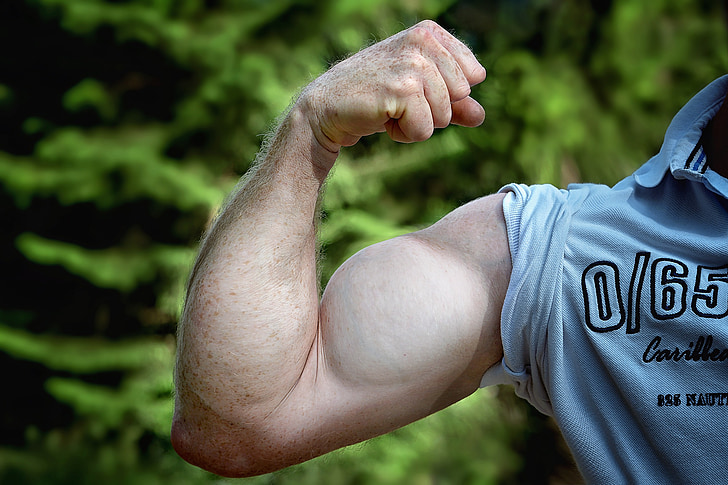
Royalty-Free photo: Photo of person showing his left arm muscle ...
Um...no! I rather like being lithe!
But, after doing some research, I've discovered somethings: sit-ups are bad for your body, especially your spine. Pushups, for the least amount of stress on the body, should always be done with the arms at a 45º angle to the body. Also, planking is really, really good for you.

So, taking the research, I've changed some things. My new workout is crunches (one rep, right knee bent, still with hands behind back, keeping back straight), push-ups (three isometric, twelve regular since my muscles are trained for 90º pushups, not 45º), squats (one rep, with waits), plank (holding it, with right arm raised, and with left arm raised)crunches (one rep, left knee bent, still with hands behind back, keeping back straight), and plank (holding it as long as we can stay in good form). I also alternate each day whether I go for a walk or a run. But I've noticed something weird--my running time is slower on the days after I stretch.

And huh, what do you know, there's some research on that...

This has been another Adventure in the Austentatious. If you liked it, tell your friends; if you hated it, tell your enemies; and if you don't care either way then tell everybody! Stay healthy, be amazing...

And happy quarantine.