Showing posts with label Social Studies. Show all posts

Wednesday, October 12, 2016

Beware the Lies of the March (of HISTORY!)


This post focuses on structure. For a more content focused discussion, please click here to go over to the vlog.

This is what I like to call a, “required post.” See, this blog started out as an assignment for class (“But why stop there?” He thought. “This is fun!” He thought. “I’m sure it won’t take up too much extra time.” He thought.), and the class is still on going. I’ve already hit the required number of posts, but two have a pre-set topic.
1)    A book review (hint hint, that one might be this post)
2)    A multi-media extravaganza, a sensual ravishment (cue more Moulin Rouge quotes)
So, today, for your enjoyment, I proudly present

Lies My Teacher Told Me: Everything Your American History Teacher Got Wrong
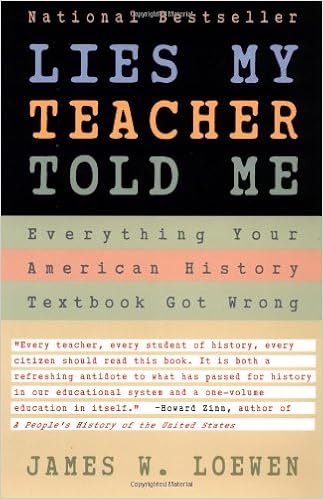

(c.o. https://www.amazon.com/Lies-My-Teacher-Told-Everything/dp/0684818868/ref=sr_1_2?ie=UTF8&qid=1476318873&sr=8-2&keywords=lies+my+history+teacher+told+me) (See? I cite my sources.)

See…old, vintage pictures!

Revisit…amazing facts locked away in the recesses of your intellect.

Learn…the sordid truth that you knew all along: your teacher was an evil, lying mastermind! Their job: torture you with the two sinister femme fatales—Miss Information, and Miss Interpretation!

Except not.

Full disclosure: I love history. No, love isn’t strong enough. I want to marry it, and have two beautiful children, and live in a suburb, with easy access to…OK, maybe not quite that much. But it’s clearly a passion of mine.

Full disclosure #2: I really enjoyed this book. I love learning new things—all those little tidbits that you bring up at parties, and then have people awkwardly walk away because they have no idea what to say—and this book is filled with fun facts.

That being said, I have a few problems with it.

First off—and I know that this will look like a weird critique, but work with me on this—this book was written in 1996. It’s been 20 years, and a lot has changed. How do I know? Because my schooling brought me into contact with two of the textbooks, years after, Lies was published.
1)   The American Nation: Used in my seventh grade Humanities class. I didn’t really like it at the time, so my opinion might be a wee bit biased.
2)   The American Pageant: Used in my APUSH class. I loved the book, and I loved the teacher who used it, and I loved the class it was in. Once again, I might be a little biased here.
So, what does this fact have to do with anything? Textbooks change. By the time that both textbooks got to me, they had both been revised; and I would say, in hindsight, that, Lies had an effect on those revisions. True, The American Nation struck me as dry and unpatriotic, but not nearly as exceptionalism-driven as, Lies makes it out to be. Likewise, The American Pageant had been greatly changed by the time that I got it. Gone was the Woodrow Wilson, clad in shining armor of perfection! Instead, we get a man—still, I might say, held a little too high—who ultimately failed in his goals. The textbook calls him out for his…erm…”helping hand,” shall we say, in America’s “back yard,” although not as much as, Lies would like. Pageant also now remarks on the later part of the Wilson presidency, particularly how he became so infirm, and how his wife took on a suspiciously auspicious role as the deliverer of his will.

Not that I’m reading anything into that.

Furthermore, Pageant does bring up the fact that Hellen Keller was a devoted socialist, a fact that the textbook presents as neither positive nor negative (which, quite frankly, is in my opinion the correct view to take about a lot of history). In other words, many of the examples that the textbook uses have become somewhat dated.

All that being said, my biggest issue with the structure of the book is how formulaic it is. Just look at the first chapter: it starts out with an introduction to show the problem, provides evidence in the form of two American heroes, compares and contrasts them, and then concludes with a solution. It’s just the basic, “compare and contrast to solve a problem” essay. In truth, I don't mind that, since most essays can be boiled down to a specific form. However, the sheer acreage the chapters take up don’t support the amount of content in them. I guess—and, let’s get real, given the size of these posts, I’m a little hypocritical here—I don’t feel as though the content really supports how much space it takes up. I feel as though the authors should have had shorter chapters, or included more examples. I know that it’s a small thing, but it makes me feel like the book was a bit of a wasted opportunity. The chapters either could have been short and sweet—the kind of thing that you can read while you’re on the bus—or so jam packed full of ideas that it would be almost impossible to argue against them. Then again, that’s just y two cents.

So, what’s my overall impression of the book? I like it, as I’ve said, and I think that it served an important niche. That being said, I think that we need a new edition. The textbooks used in classes have a powerful impact on what students learn. Even if a student never cracks one open, the teacher still aligns what they teach with the material—giving the course a sense of cohesion—so that those who do read are not as confused. And, there is a bit of a textbook problem these days.

Texas is one of a few states that recently changed their history curriculum. The move is towards what I would call a more biased history, one that focuses on the positives and always tries to paint the US in a healthy light. In other words, it rose tints the lenses that we use (http://www.huffingtonpost.com/news/texas-textbooks/ [I'm not actually that fond of Huff Po, but I didn't feel like clicking on another source]). This fact wouldn’t be too much of a problem, except that the state of texas holds an almost alarmingly disproportionate percentage of the textbook market. Basically, if Texas makes a choice, it affects everyone, even those from states with vastly different curriculum.

That fact is why books like, Lies are important. They not only correct misconceptions, but give teachers and students an alternative to the history that they are taught. Clearly, I don’t think that history should be positives. History is this wonderfully messy, uncomfortable, undulating thing, where the good idea of one period turns into the problem of another. By only teaching a positive view of history—by ignoring what, Lies brings up—we teach kids that history is linear, and that nothing we do can go wrong. So, when things do go wrong, we have intense nostalgia for the past, even when it’s just as messed up as the future. So, I urge you, look at the kind of messy history brought up in, Lies—look beyond this overly patriotic habberdash that counts as, “the one true history”—and find something more real, more attainable, and altogether more human.

This has been another exciting adventure in the austentatious! If you liked it, tell your friends. If you hated it, tell your enemies. And if you don’t care either way, then tell everybody. Peace out.

Sunday, October 2, 2016

A Cultural Transformational Translation

(Click here for the vlog)
Sooner or later, every teacher should give their students a primary source. They offer a glimpse into the culture of a place, in the voice of the people who live there, and provide a perspective that students would otherwise have access to. For example, for the past few years I've been enjoying a series of articles on Mental Floss about the battles of WWI (http://mentalfloss.com/article/86941/wwi-centennial-tide-turns-against-romania). Believe it or not, we've reached the centennial of, "the war to end all wars." The way that history is taught in most classes, wars seem to have an inevitable conclusion. Either this sense comes from the fact that many people already know these stories--and, indeed, we are all here to tell them--or an idea that, due to factors early on in the war, we can deduce that one side was simply destined to win. I could go on at length about this problem, but I think that's a post for another time. Back to my original point: the mental floss articles include telegrams, diary entries, and letters from those who were experiencing these events first hand. Within those letters, we see a different narrative than what is presented in most history classes: one of terror, uncertainty, and a sense of being beaten down. In this way, primary sources add life to a classroom, and help challenge some of the fundamental views we take about historic events.
But, primary sources don't just have to be about history. By reading newspapers and speeches from foreign countries (or watching translated/ subtitled videos), we get a sense of what those cultures value. However, there's a slight wrinkle in the proceedings...

"Oh yay," you might say, "he's finally stopped monologueing and is getting into the good stuff." Pishaw, good reader. The stuff above is perfectly good too, if a little dry. But, if our news is anything like life, then we as a society much prefer to look at the negative (evidence: http://www.bbc.com/news/blogs-news-from-elsewhere-30318261).

See, translations will never be perfect, regardless of what they're talking about. Let's take, for example, these two texts:

a) A news article about the peace process between the Columbian government and FARC:
"Hace décadas, una bomba del IRA (Ejército Republicano Irlandés) colocada en un cubo de basura en el centro de Londres arrojó al suelo a un joven colombiano que trabajaba para la Federación del Café." (http://www.bbc.com/mundo/noticias-america-latina-37506432)

b) The first stanza of, Versos Sencillos, a poem by an early Cuban revolutionary, Jose Marti.
Yo soy un hombre sincero
de donde crece la palma,
y antes de morirme quiero
echar mis versos del alma.

Now, let's try translating word for word, with no change for meaning:
a) It does decades, a bomb of the IRA (Irish Republican Army) placed in a cube of garbage in the center of London threw into the air a young Colombian who worked for the Federation of the Coffee.

b) I am a man sincere
where grows the palm tree,
y before I'm dead I want
to throw the verses of my soul.

So, while both of them are understandable, they leave a lot to be desired. Let's try that again, this time with being a bit less exact:

a) Decades ago, a young Columbian--working for the Coffee Federation in the center of London--was thrown into the air by a bomb planted in a garbage can by the IRA.

b) I am an honest man
from where the palm trees grow,
and before I die, I want to write
these precious words of my soul.

I think that we can all agree, much better. So, I changed some word, moved them around, and got the general gist. What does any of this really have to do with class? Well, first off, let's take a look at the first words of the news story, 'a'. (For more discussion about the poem--and translations in general--please see this video.)

1a) Decades ago...
1b) It was only a few decades ago...
1c) Time: Decades in the past.
1d) It seemed a day like any other, mere decades ago,
1e) When moments seem to last years, a couple decades can seem a lifetime.

Each of these five sentences/ phrases gives the same general gist: we're not talking about now, we're talking about something that happened a while ago. But, here's the thing: each option gives a slightly different feeling. 1c sounds very clinical, while 1d gives a slight feeling of trepidation. For an article about a peace process (which, I have just found out, failed the plebiscite: http://www.bbc.com/news/world-latin-america-37537252), the tone can convey everything. A more sinister start can make the deal seem treacherous, while a more upbeat tone transforms it into the greatest thing since sliced bread.

The fact of the matter is, most Social Studies teachers are trying to form some sort of narrative for the whole year, and the materials that we choose to provide affect how that material is received. The tones that teachers choose to use in their texts--and there is usually more than one translation option--affect how the class views the events. Moreover, using a variety of materials, with a variety of view points, can really help flesh out a boring lesson. Just don't go too far...

Teacher: Hey everyone, today we're going to learn about the Code of Hammurabi!
Class: Groan!
Student 1: But we already read about that!
Teacher: Well today we're going to watch a video about a culture that still uses it.
Student 2: Really?
Student 3: Wow, they weren't kidding when they said an eye for an eye.
Student 4: Look at the blood fly!
Student 1: We should do this in class!
Teacher: Classroom-material integration! (TEACHER gives thumbs up).

Uh, no.

Monday, September 26, 2016

El Defenso Del Economic History


(if you get the title joke, you know your Latin American historical texts)

            Believe it or not, the way that history is taught is a choice.

            “Well, of course it is!” You might say. “It would be practically impossible to fit the entire canon of human history into a single class!” To which I would say:

The totality of human history (in 3 sentences): A bunch of people lived. They did stuff, and made more people to do more things. Then they all died…eventually.

There, boom, end of story…except not really. See, dear reader, the drama is in the details. There are only so many historic events that someone can reasonably cover in one year. But, that’s an old problem, and one that most people already know. What’s equally important is what lens we view history through.

“Lens? Who cares about lenses. My historical vision is fine, 20/20, absolutely crystal clear!” Oh, really? Then what do you think of this little statement:

The Spanish colonization of the Americas led to the downfall of imperial China.

You pause for a moment, then look at me, wondering if I’m serious. I am—really, truly, unequivocally so.

“Preposterous…asinine…completely indefensible,” you might say, “those are two utterly disparate facts. They share not an iota of historical commonality among them. I know my history. I did well in high school.” Nice SAT words, dear reader. And from a social lens, I’d agree. There just wasn’t enough direct social interaction between Spain and China between the 15th and 20th centuries to justify this view.

But what about from an economic lens? Let’s look at things from the point of view of—wait for it…wait for iiiiit—Economic HISTORY (video game-style-crescendo bum-bum-bum-buuuuuuuum! Wooo!)

Economic history looks at the world in terms of two ideas: trade and resources. Using that point of view, I can actually defend that statement (you: grumble mumble mumble). See, since Antiquity, the flow of trade from west to east—and east to west, with north and south thrown in there as well, but slightly less important right now—had been fairly constant. Oh, a war here and there had interrupted it, but by and large what would later be known as the Silk Road (aside from the name, no relation to the website) was already around during the time of the Romans.

So, what the Bactrian does that have to do with Spanish colonization?

Well, Europe, Africa, and Asia—all playing equal parts here—were largely a closed system for several thousands of years. Compared to the modern day, there wasn’t a lot of resource mining, so for the most part the supply of bouillon was fairly set. China especially benefitted here, being able to set up a stable system that lasted from antiquity into the modern era.

But all of that changed when Spain began colonizing the Americas (dun-dun-duuuuuh).

The idea that many people have about los conquistadores is a group of men destroying empires—Tenochticlan, the capital of the Aztec empire, has a reasonable estimate of about 50,000 people (https://www.google.com/url?sa=t&rct=j&q=&esrc=s&source=web&cd=5&ved=0ahUKEwjVt9rF0K7PAhVM8GMKHbEpAuYQFgg6MAQ&url=http%3A%2F%2Fanth.la.psu.edu%2Fdocuments%2Fevans_2013_tenochtitlan&usg=AFQjCNHIiC1VZ_qBwND-VU7OdYsmfHeBDw&sig2=0qweTmZJkyhCHxCFQxheHw&cad=rja)—and bringing back gold. Plentiful gold. Mountains and mountains of gold. But, we’re not going to care about gold here. Instead, the culprit in this case is gold’s brother, silver. (warning: while the rest of this is generally accurate, I haven’t had time to dive in depth as much as I’d like. Some of it may be edited at a later date, when I have better info). See, one of the great stable features of China was that it was on the silver standard. I’m not saying that people were carrying around silver coins—the average peasant would probably never see any silver in their lifetime—but that the value of everything was tied to the value of silver.

That’s all fine and dandy when the supply of silver is all but set. However, when the amount of silver in the system changes drastically, it can cause problems. Lose a lot, and you suffer deflation, and suddenly people hoard goods because they are rising in value so fast. Have the opposite problem, and you suffer inflation, where suddenly all currency is worthless. Want some contemporary examples? Deflation: Japan. Inflation: Weimer-era Germany, and Zimbabwe.

It might have taken a century or two, but eventually the hoard of Spanish silver…well, formerly-American silver flooded into China through legitimate trade. The resultant inflation weakened the imperial economy, causing wide-spread problems. Add in discontent from the opium wars, and you have a once-stable system ripe for a fall.

So, what does all of this have to do with history class?

The lens that we view history through affects the narrative that we tell. Most history classes are told from a social point of view, to the effect that it could be called the standard POV. But that view is limited—just like all of them—in that it cannot always tell the whole story.

How, then, to take this into teaching?

Well, as far as I can see there are two paths. Path one involves focusing on one kind of history—social, military, economic, intellectual, or conflict, to name a few—with the goal of presenting a single, solid narrative. Path two involves mixing the lenses. Both have their pros, and their cons, and in the end it’s the teacher’s decision. The only bad choice is to ignore the options in terms of simplicity, because that choice helps no one, and only teaches students a diminished view of what history can be.

Tuesday, September 20, 2016

Inquiry vs Projects! The Cage Match of the Century


I got a feeling (ooh-ooooh) that a lot of people think of school wrong. Most people, when they think of school, inevitably find a child’s-eye view of their own experiences: the teacher speaks, the student listens, and learning happens. Except, it doesn’t. The lecture—the stereotypical teaching model—is almost shockingly bad at getting most people to learn. That’s why many schools are moving away from it, and into more interactive models.
            Two such types are Project-based and Inquiry-based learning.

            “Now, wait a second,” a reader might say, “what’s the difference?”

            Well, astounding person who is interacting with the text, the difference is this: Project-based-learning centers on the students learning through doing a project, while Inquiry-based-learning centers on the questions that students ask and want to learn about. There’s definitely some overlap between the two, but let’s look at some examples in a Social Studies classroom to figure them out.

Example 1) Trade Routes
         Let’s say that a history class is focusing on ancient trade routes. While the teacher could wax at length on the importance of the Silk Road and the trans-Saharan trade through Timbuktu, this particular educator finds that idea really dully. Truly tedious. Absolutely, incomprehensibly boring. Instead, our outstanding exemplar of modern educational principles decides to try out either a project-based or an inquiry-based lesson. After much research and thought, our pensive protagonist lists out his discoveries in hopes of deciding the best approach for the cerebrums of his classroom.

1)   The Project
a.    Students are given 20 trade-route cities. They must research each, place them on a map, draw a line between them to show the most common way of getting there, and write three facts about each.
2)   The Inquiry
a.    Students are given three short primary sources about the Silk Road. They will then be asked to come up with questions, and research the answers.
3)   The Combination
a.    Students will be shown a brief documentary about the trans-Saharan trade, and will then be asked to come up with their own questions about trade routes in general. They will then research the answers to their questions, and be asked to present their findings to the class in the form of a geographical map.

First, a round of applause for our brave explorer (thunderous applause)—now, as the casual observer might note, there’s a lot of difference between the three here. That’s kind of the point. After all, if you’re trying to convince someone that there might really be four species of giraffe instead of just one (http://www.bbc.co.uk/newsround/37328191), you’re not going to start by saying,
         “Well, they’re all giraffes, mammals, and have really long necks.” For one, you should have mentioned Lamark (I’m famous for being so close, but so wrong). For another, if your goal is to convince people how something is different, setting up the similarities is irrelevant to the end point, and might even be counter productive.
However, because I’ve set up the differences, a brief overview of the similarities: 1) Both methods involve a classroom…usually. Learning shouldn’t always involve a classroom, but let’s get real. 2) They both need context to work. It’s possible to drop a student into the middle of a lecture, and have them get just as much out of it as anyone else. Drop a student in the middle of a project, or—the horror—sit them down, and ask them what questions they have about the totality of human knowledge, and they’re liable to not get far. Context shows them where they need to work, and gives direction to the kinds of questions they have. Lastly, 3) they both involve a lot of student input. Students drive projects, while student interest powers inquiry like an RC car hooked up to a nuclear reactor. Even an inquiry-based lecture (my students like blood and guts, the Vikings tortured using blood and guts, therefore I shall lecture about Viking torture) requires some amount of student input to come to fruition. And student input drives motivation, which drives self-efficacy, which drives learning.

So, to summarize: Lecture bad, student involvement good.

Tuesday, September 13, 2016

Take Every Moment as an Opportunity

This is hopefully going to be a short post. One thing that I have learned in life is to take every opportunity that I can. Now, this trick doesn't always lead to success--in fact, there have been several failures along the way--but every one that I've taken has helped me grow, learn about the world, and just become a better overall human being. An interesting part about opportunities is that they can be terrifying. And it's easy to forget this when the moment has passed, which can lead to a lot of empathy problems down the road. This issue is especially true for teachers, who spend all of our days speaking in front of other people, and really putting ourselves out there. "After all," one might say, "if I talk in front of a class every day, certainly the student can do it no problem for 10 seconds." For some students, those 10 seconds might feel like an eternity. Just food for thought.

Anyway, speaking of opportunities, I now have a Social Studies blog (yay!) which gives me many options that didn't exist before. One such example is the ability to post things that wouldn't fit else where in context. See, I rather like words--I find them fascinating in fact--and one of my favorite aspect is the ability to play with them. Alliteration, for example, is one of my pleasures. Another is rhyming, and what better way to show off rhyming than with a song? This is a little ditty that I wrote last year to the tune of Orfee aux Enfer (https://www.youtube.com/watch?v=rCDwTguKjIA) (Yes, I know that the second e should be accented, but I don't have accents on my work computer, grrrrr...), and it relates to Social Studies because a) music is just another piece of the human social aspect and b) it has to do with the Reformation, which is history. Without further ado...

The Reformation Song!
By Austin Schock

(For my stirringly off-key rendition, click here)
(we ignore the first 8 minutes and 26 seconds of the piece)
Martin's antithetical
His works are all heretical
"90 theses, and five more,
nailed to the chapel door!"
Calvin says, "There's something there,
the pope is wrong and we don't care!
Everything is predetermined
No free will and that's for certain."

Ref-Or-May-Tion
Changing European nations
Dee-Vee-Ay-Tion
From the papal proclamation
Ref-Or-May-Tion
There are protestant formations
Pro-tess-tay-tion
'Gainst the orthodox
'cause that's the crux
of all this rucks
no time for talks
we're out of ducksOh oh oh!
Oh oh oh oh

Oh, there is much converting
The Catholic church is hurting
Biblical translations, Oh, and by the way
There are bloody wars, now
So you should all go bow
To the nearest lord and really pray

and

Hope he is of the right sect
if he's not then defect
otherwise you'll have a really really horrid day
where they storm the castle
Huguenotic hassle
Killing everyone in every way

and

now we jump to '45
the Catholic church is still alive
"Counter reformation crew,
meet in Trent at 22!"
Keep the Pope's supremacy,
Sacraments, celibacy...
We'll stay strong
for so long
Lost a king
(marriage thing)
They'll be war
tons galore
only this and so much more and more and more and more

and

Oh, there is much converting
The Catholic church is hurting
Biblical translations, Oh, and by the way
There are bloody wars, now
So you should all go bow
To the nearest lord and really pray

and

Hope he is of the right sect
if he's not then defect
otherwise you'll have a really really horrid day
where they storm the castle
Huguenotic hassle
Killing everyone in
e-ver-y conceivable way
Hanging, flaying, and that is not OK

"Now can't we all just get along?"
"Well, no we can't 'cause you're just wrong!"
"Hey that is not a thing to say."
"Well now you're dead so it's OK!"

Oh my gosh, Europe's exploding
I'm leaving, let's go exploring
All right everyone we have to stop right here, right nooooow!

Sunday, September 11, 2016

Holy Catalan Independence, Batman!

So, after much debate internal I on BBC decide. My first post will be in response to

(drum roll) dddddddddddddddddddddddd...

 THIS ARTICLE:

http://www.bbc.com/news/world-europe-37334382 YYYYYAAAAAAAAAAYYYYYYY!!!!!!!

Basically, quite a few members of the populous of the Catalan region of Spain are again protesting for the right to hold a referendum for independence from Spain.

"Now, wait a second," the average American might say, "they've been together forever. They're like peanut butter and jelly! Why would they do this? Why should I care? Where even is Catalonia anyway?"

Thank you, average citizen, for such a timely leading question. Catalonia is a semi-autonomous region in the north-East part of Spain. For more information, skip to the bottom of the page. Back to the topic at hand: Catalan Independence. What's going on?

Well, a lot of things. And I would argue that social studies--particularly history--come in handy.

After all, that's the point of history: it gives context to the present day. So...context, ARISE!
1) Language
       Etymology--the study of the history of words--is absolutely fascinating. For example, we know from texts (See Romance de la Perdida de Alhama <http://www.poesi.as/indx0036.htm>, written just after the Reconquista, for details) that fairly modern Spanish was extant by the time Ferdinand and Isabel were married in 1492, uniting the kingdoms of Aragon and Castile. However, that part of the Iberian peninsula wouldn't be called Spain until their son, Carlos I of Spain, took the throne.

Fun fact, most languages are named after their country of origin:
English comes from England.
Japanese comes from Japan.
German comes from Germany (or, "Aleman es de Alemania" if you speak Spanish).

So, if there was no Spain for Spanish to come from, what did they call the language? Castilian, nothing more than a glorified regional dialect that took over its neighbors. But wait--you say--what does this have to do with Catalan independence? Simple: the regional dialect of Catalonia is Catalan, a separate language from Spanish.

This isn't a story of people starting together only to grow apart. These are people with a completely different language being forced together by monarchs failing to have more than one child. But is that really enough? Not by itself, I would argue, but there are other factors to consider.

2) Location
There is a saying: Africa starts past the Pyrenees. Basically, the culture of the Iberian peninsula is just weird compared to the rest of Western Europe. There's a very good reason for this, too. See, for 700 years, Spain (and, yes Portugal, you get a mention here too) was under control of muslims. First, as a part of the Umayyad caliphate--where it was known as Al Andalus--until it eventually fractured into several smaller muslim kingdoms.

Once again, what does this have to do with Catalan?

The Pyrenees are a mountain range separating the Iberian peninsula from the rest of Europe. As anyone who has read, The Song of Roland knows, this is where the Franks halted the muslim advance, and started to retake the land from those heathens with their algebra (named after one of the works of one of its muslim inventors <http://www.etymonline.com/index.php?term=algebra>) and translations of pagans like Plato and Aristotle.

Sorry, got off on a tangent there.

Catalan was one of the first parts of the peninsula to be reconquered (or Reconquistado in Spanish), meaning that it was one of the areas that had the least amount of muslim influence. In the grand scheme of things, the difference of 100 years or so is not that much, but it still gives Catalonia a place in history and culture that is not reflected in the rest of the country. Bordering the Pyrenees also gives it cultural connections to France--such as sharing the Occitan language (one of my favorite languages by name only. My favorite is Walloon, because it's just so much fun to say. WALLOON!), and being in the same historic region (at least, according to Wikipedia, so please take that with a grain of salt the size of the meteor that killed the dinosaurs).
In short, Catalan can be seen as the gateway into Europe, which gives it a unique flare.

3) Economics
Now we get to more modern stuff, and the things that are really mattering in these elections. See, the previous stuff gave the catalonians a sense of identity before modern times (and helps explain their many attempts at gaining independence over the centuries), while economics--if many are to be believed--is what makes the world go round (actually, it's physics, having to do with forces and conserving the momentum of tiny particles that started so far back too few people actually care).
See, here's the thing. According to the article that started this all, Catalonia has about 16% of Spain's population. However, they produce about 19% of Spain's total Gross Domestic Product (GDP). It also makes up about 6% (quick and dirty % math, I'm definitely a little off) of the total land of Spain.

Read: Catalonia is an economic powerhouse of Spain, at least in terms of power/ square mile.

During the reign of Franko, the region underwent intense industrialization (he destroyed any sense kind of autonomy, and did his best to rid them of the Catalan language in official use). These days, with Spain moving--as are many "western" countries--towards a more service-centered economy, unhappiness with the government in Madrid is high (http://www.bbc.com/news/world-europe-29478415) with many feeling as though they are a powerhouse--they hosted an Olympics in '92, and got off far better with less debt than many of the more recent games--and that they are being taken advantage of. Are they? Well, according to the article cited a few sentences back, Catalonia received about 8,500,000,000 (8.5 billion) euros less in aid than it sent to the government in the form of taxes in 2011.  So, given that big (not, "US Deficit" big. More, "most people will never see that much money in their entire lives" big) number, it's very understandable that the region would feel taken advantage of.

So, why should I care?
This is the big question. It's one that students are constantly asking, and one that so few teachers can adequately answer.

But I'm going to try.

So, independence for Catalonia is the result of a process that has been going on for a very long time. There have been many attempts at leaving Aragaon, Aragon & Castile, and Spain over the centuries, and they have all failed. However, understanding why there was this feeling that independence was an option helps explain why Catalonia is still considering independence now.

It also applies to our own country.

Catalonia could be viewed as a laboratory, to see how these factors can potentially play out. Take, for example, the economic argument of feeling taken advantage of. Believe it or not, most states do not receive a 1-1 return for every tax dollar sent to Washington DC. Some--such as Mississippi, New Mexico, Alabama, and Louisiana--receive more in aid than they send in taxes (<http://www.theatlantic.com/business/archive/2014/05/which-states-are-givers-and-which-are-takers/361668/>). Others--such as Delaware and Minnesota--receive less than they give (hmmm...to what extent is a state's reputation as a giver or a taker affected by the dominant political party? What about how it votes in presidential elections?). This is the exact same situation that exists in Spain, where Catalonia is one of the big givers. Am I saying that Delaware is suddenly going to try leaving the union? No. However, as in Spain there are definite regional differences in America. UNLIKE Spain, there is a unifying language, and a fairly unified culture and structural system.

In terms of America, Catalonia could be used as a, "what if" scenario. Mostly, what if we had modern day independence attempts in here? Would the central government allow it? Or, as with Madrid, would they block it? Currently, there are many independence movements, but they are usually small and at the fringe. What influences them? What drives them? What do they want, and how do they hope to achieve it? By understanding the events that are going on around us, as well as the history that provides them context, we can find the questions to help us better understand the places where we live.

The fun part!!!!
First, some back story (apologies for the lack of citations. Most of this part is just memory from a plethora of history and Spanish classes, hence its brevity): Let's just say that for this post, Spain's history starts with its conquest by Rome. It then became the province of Hispania. When the Western empire fell, Hispania was conquered by the Visigoths. The Visigoths then lost it to the muslims (yay, Umayyad Caliphate). They managed to hold it for about 700 years. During that time Catalan (a principality under Barcelona) appeared, and soon joined Aragon (a kingdom) [http://www.bbc.com/news/world-europe-20345071]. In 1492, the Christians--under Ferdinand and Isabella of Castile and Aragon--conquered Grenada, ending muslim rule in Spain. The two kingdoms stayed united when the monarchs had a single child. After that, they were conquered by Napoleonic France--only to be freed at the end of the war. They then endured a Civil War, where they were conquered by the Spanish fascists under Franco. When he died, power was given to Juan Carlos, heir to the old throne of Spain, who restored the kingdom without conquering it. So far, the kingdom has endured.

Bonus fun feature (lucky you, dear reader):
Technology is amazing, in that it can both divide and unify. In America, the advent in TV has unified English. Regional dialects and slang are disappearing, replaced by an odd standard (<http://www.theatlantic.com/technology/archive/2016/09/bat-hides-and-frog-stranglers/499046/>), which sounds decidedly west coast! For places like Spain, however, technology could be see as a divider. Yes, it would not surprise me if their Spanish is undergoing a unifying like our English (I haven't done the research, but I would love for someone to do so and report on it); however, it is also giving new life to formerly dying languages. Where once regional dialects like Catalan were relegated to conversations and the occasional eclectic newspaper, technology has given them a platform to communicate to larger audiences in broader ways. There are undoubtedly Catalan language TV stations, websites, blogs, youtube videos, etc. (There's even an ATM in the vatican that has the option of dispensing cash in latin. IN LATIN. This is a language that, by all rights, shouldn't even have a word for ATM.) Technology is another factor that influences how people see themselves and the world around them. Without taking technology into account, the modern student of current cultures sill no doubt only get part of the story, and perhaps even miss out on what might be the most important part.